Top gaming earbuds: The gear that saved my final BGMI circle
A gunshot arrives roughly 100ms late over ordinary Bluetooth, and that is enough to turn a correct BGMI read into a late peek. In the final circle, the problem is not sound quality in the lifestyle-audio sense.
It is timing: footstep, direction, distance, then response.
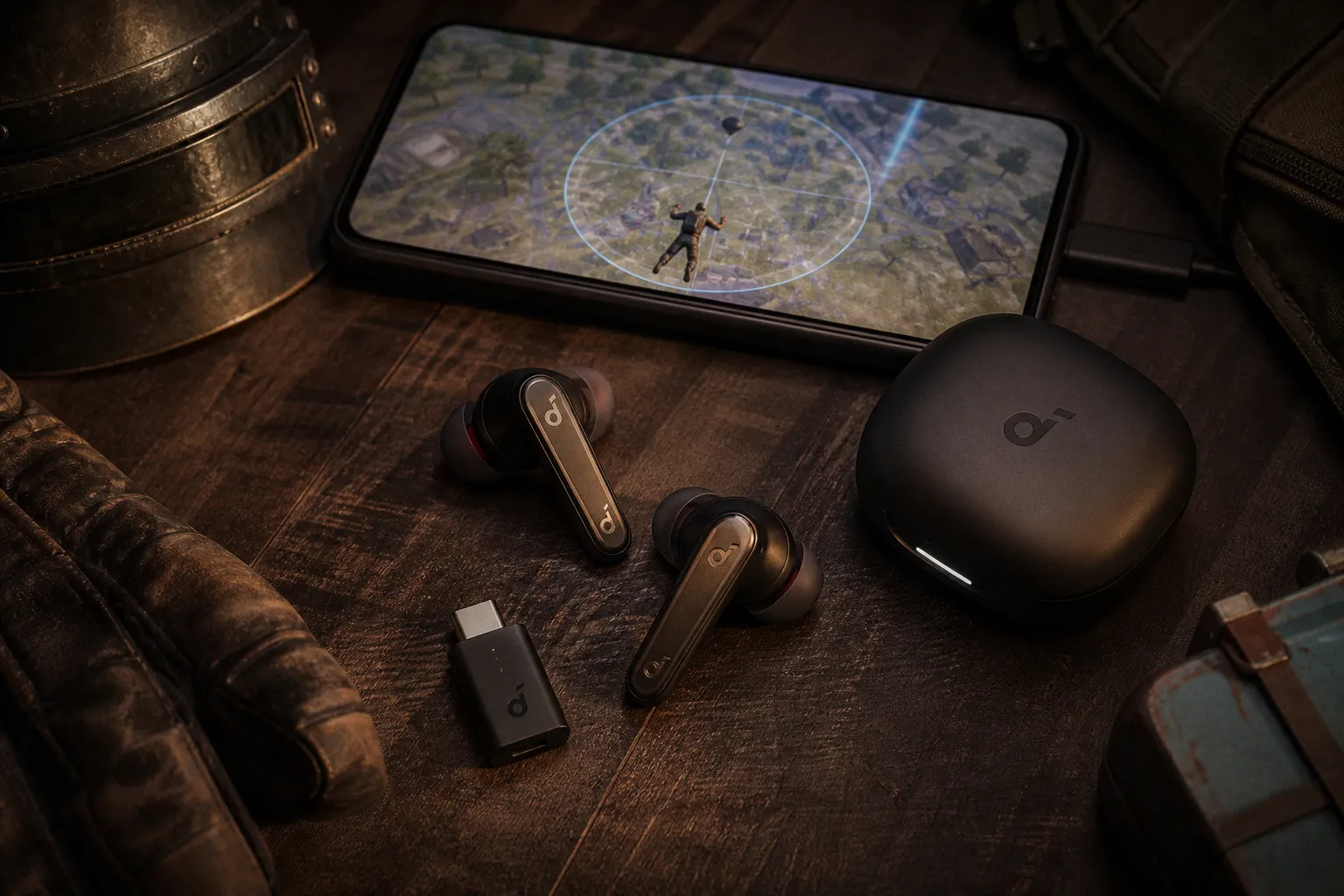
The top gaming earbuds now solve that problem with a less glamorous piece of hardware: a 2.4GHz USB-C dongle. The useful models push reported audio latency below 30ms. Standard Bluetooth connections often exceed 100ms. That gap is not subtle when a squad is closing from two angles.
For competitive mobile play, “low latency” is also one of the most abused labels in the accessory market. Bluetooth 5.3 on a box does not prove low latency. LDAC and LHDC 5.0 do not make earbuds faster for gaming either; high-resolution codecs can add processing delay. The relevant question is simpler: what connection path is used when the match starts?
The 2.4GHz shift: Bluetooth is no longer enough
Bluetooth TWS earbuds remain convenient. They pair quickly, fit in a pocket, and work with almost every phone. For casual music or a few unranked matches, that is sufficient.
For BGMI scrims, it is not.
The Bluetooth audio path involves encoding on the phone, transmission, decoding in the earbuds, buffering, and DSP processing. Gaming modes can reduce that chain, but they do not erase it. A 40ms gaming-mode claim is credible on a properly optimised TWS pair. It is still not the same class as a dedicated 2.4GHz radio link.
A USB-C dongle changes the route. The phone sends audio through the dongle, which maintains its own direct low-latency connection with the earbuds. There is less dependence on the Bluetooth stack, phone firmware behaviour, codec selection, and background radio congestion.
That is why dongle-based sets are now the serious option among the best TWS for mobile gaming.
| Connection method | Typical practical position for BGMI | Latency profile | Main limitation |
|---|---|---|---|
| Standard Bluetooth | Casual play, calls, media | Often over 100ms | Audible delay in gunfire and movement cues |
| Bluetooth Gaming Mode | Ranked play on a budget | Around 40–54ms on supported models | Performance can depend on phone brand and software |
| 2.4GHz USB-C dongle | Scrims, tournaments, final circles | Under 30ms on leading models | Occupies the USB-C port |
| Wired USB-C / 3.5mm | Maximum consistency where supported | Very low | Cable management and port compatibility |
The caveat is physical, not theoretical. A dongle occupies the USB-C port. That matters on phones running clip-on coolers, pass-through charging hardware, or certain trigger layouts. A serious mobile setup can become crowded fast: cooler cable, charging lead, trigger clamps, and now an audio receiver.
A 2.4GHz dongle does not create “zero lag.” It removes enough delay that audio and action stop arguing with each other.
Latency numbers: what they change in an actual fight
Latency figures are only useful when translated into match behaviour.
At around 100ms or more, the sound of a shot is delayed enough that players start compensating unconsciously. The crosshair moves after the cue. A push around a wall feels less readable. Close-range fights become visually driven because the ear has stopped being reliable.
At 50ms, the result is better. The delay may still exist, but it is less disruptive in medium-range engagements. This is where optimised Bluetooth gaming modes sit.
Below 30ms, audio becomes far more usable as a reactive input. It does not make a player faster. It removes one artificial delay from the chain.
Three situations expose the difference:
1. A close footstep on a stairwell.
In a compound fight, the relevant detail is not merely that somebody is nearby. It is whether the sound has moved from the lower flight to the landing, and whether it is left or right of the centre line. Late audio produces late pre-aim.
2. A third-party spray in the final zone.
The first burst gives information: weapon direction, approximate range, whether the enemy is shooting downhill, and whether there is a gap for a rotate. If the cue arrives after the visual chaos begins, its value drops sharply.
3. A vehicle pull-up behind cover.
A delayed engine cue can make a squad react to where the vehicle was rather than where it is. That is exactly the sort of small timing error that creates a bad angle at the wrong second.
Manufacturers frequently package these features as “ultra-low latency” or “esports audio.” The numbers deserve more attention than the slogan. Under 30ms through a dongle is the current meaningful threshold. Around 40ms through Bluetooth gaming mode is workable. A quoted 54ms can be acceptable, but software and handset restrictions matter.
The OnePlus Buds Pro 2, for example, can reach a minimum latency of 54ms, but that performance is tied to specific OnePlus flagship phones running OxygenOS. That is not a universal result. Buy them for a non-OnePlus gaming phone based on the headline number, and the calculation changes.
The hardware shortlist: Inzone, VR P10, Cetra, and Realme
The market has split into two clean categories: dedicated 2.4GHz products and Bluetooth-first earbuds with a gaming mode. Both have a place. They should not be treated as direct equivalents.
| Model | Low-latency route | Reported latency | Useful hardware detail | Best use case |
|---|---|---|---|---|
| Sony Inzone Buds | 2.4GHz USB-C dongle | Below 30ms | Up to 12 hours on one charge | Long competitive sessions |
| Soundcore VR P10 | 2.4GHz USB-C dongle | Under 30ms | Dongle-led wireless connection | Players prioritising response timing |
| ASUS ROG Cetra True Wireless | App-optimised Gaming Mode | Not specified here | 27 hours total battery with ANC on | Mixed gaming and daily use |
| Realme Buds Air 5 Pro | Bluetooth Gaming Mode | 40ms | 11mm driver plus 6mm micro-planar tweeter | Value-focused mobile gaming |
| OnePlus Buds Pro 2 | Low-latency mode on supported phones | 54ms minimum | OxygenOS-dependent optimisation | OnePlus flagship owners |
| Razer Hammerhead HyperSpeed | HyperSpeed 2.4GHz dongle | Not specified here | ANC and dedicated dongle | Noisy environments, multi-platform use |
Sony Inzone Buds: the cleanest tournament-session case
Sony’s Inzone Buds remain one of the more coherent answers to competitive mobile audio. The dedicated 2.4GHz USB-C dongle delivers latency below 30ms, and the battery figure matters more than usual: up to 12 hours of continuous use on a single charge.
That is not a decorative spec. A long scrim block, warm-up matches, VOD review, and a few additional ranked games can exceed the practical endurance of many conventional TWS earbuds. Charging one earbud between maps is not a serious workflow.
The Inzone formula is straightforward:
- A direct wireless path for low-latency play.
- Enough single-charge runtime to avoid mid-session case dependency.
- USB-C compatibility that suits current Android gaming phones.
The limitation is also straightforward. The dongle has to live somewhere. If the phone needs active cooling and wired charging at the same time, the setup requires planning. Players who use a cooler with its own USB-C pass-through need to verify physical clearance rather than assuming everything will fit.
Soundcore VR P10: latency-first, with one compatibility question
The Soundcore VR P10 also uses a 2.4GHz dongle and claims latency under 30ms. Its appeal is not subtle: it targets the specific weakness of Bluetooth audio in fast games.
For BGMI, this makes it a stronger technical proposition than a premium music-oriented TWS pair that merely includes a gaming toggle. It is built around the correct bottleneck.
However, there is one detail that should remain unresolved rather than guessed at. Exact latency behaviour with iPhone 15 or iPhone 16 USB-C ports, compared with Android devices, is not firmly established here. The dongle may physically connect, but mobile gaming buyers should not assume identical performance across operating systems.
For Indian Android players, the VR P10’s core advantage is clear. It prioritises the right metric. It does not need an elaborate codec story to do so.
ASUS ROG Cetra True Wireless: broader feature set, less clean latency case
The ROG Cetra True Wireless uses an app-optimised Gaming Mode that synchronises audio and video for competitive use. It also offers 27 hours of total battery life with ANC enabled.
That total runtime figure is useful, though it needs to be read correctly. “Total battery” includes the charging case. It is not the same as the Inzone Buds’ 12-hour continuous single-charge figure. For a long LAN day or a long mobile grind away from a power point, those are different kinds of endurance.
The Cetra is the more flexible all-round product. ANC, app integration, and a large total battery figure make sense for someone carrying one pair of earbuds through travel, media, calls, and games.
But flexibility is not automatically performance. If the buying decision is strictly about the fastest and most consistent gunshot-to-ear response, a verified 2.4GHz dongle path remains easier to recommend.
Realme Buds Air 5 Pro: the sensible Bluetooth ceiling
The Realme Buds Air 5 Pro reaches 40ms in its dedicated Gaming Mode. That puts it in a practical middle ground for low latency earbuds in India.
Its driver configuration is more interesting than most budget-oriented gaming claims: an 11mm bass driver paired with a 6mm micro-planar tweeter. In BGMI terms, the benefit is not “big bass.” Excess bass can actually blur useful low-frequency information. The useful part is separation: gunfire, vehicle noise, reloads, footsteps, and voice comms should retain distinct edges rather than collapsing into one dense low-end layer.
At 40ms, Realme is not competing with 2.4GHz dongle products on raw latency. It does not need to. It is a Bluetooth-first option for players who want fewer accessories, no occupied USB-C port, and a materially better gaming response than ordinary TWS.
That distinction matters. A 40ms mode is a good result. It is not a reason to pretend a 2.4GHz dongle is redundant.
Directional audio: latency alone does not locate the enemy
Low delay gets the cue to the player sooner. It does not guarantee that the cue is intelligible.
Directional performance in mobile shooters depends on channel matching, driver control, tuning, fit, game audio mix, and the phone’s audio implementation. “Spatial audio” is often used loosely, but a competitive player should care about something narrower: can the earbud keep positional cues separate under pressure?
The most useful audio traits for BGMI are not necessarily the ones that make music sound dramatic.
- Controlled upper bass. Too much mid-bass masks the texture of footsteps and makes vehicles dominate the mix.
- Clear lower mids. This range carries a large amount of weapon body, movement detail, and voice communication.
- Stable treble energy. Footsteps and small environmental cues often rely on higher-frequency detail. Overdone treble becomes fatiguing; recessed treble removes information.
- Consistent left-right balance. A small channel imbalance can distort positional judgement more than many players realise.
- A secure seal. A loose ear tip changes bass response and can destabilise directional perception from one minute to the next.
The Realme Buds Air 5 Pro’s dual-driver design is relevant here because it aims for better separation, not merely volume. The same applies to any pair marketed with spatial features: the value is in whether individual sound layers remain distinct in a crowded engagement.
ANC deserves a more qualified reading. Noise cancelling gaming earphones can help in noisy rooms, at events, or around traffic and fans. The Razer Hammerhead HyperSpeed, for instance, pairs ANC with a dedicated HyperSpeed 2.4GHz dongle. That combination has a clear use case when the environment is working against the player.
ANC does not improve in-game positional data. It reduces external interference. Those are different functions.
The best positional cue is not the loudest one. It is the one that reaches both ears on time without being buried under bass, noise, or codec delay.
Battery, heat, and the USB-C bottleneck
Mobile esports sessions are not designed around a neat two-hour battery test. A realistic schedule can include training rooms, scrims, ranked warm-ups, breaks, stream monitoring, and post-match review. Earbuds that need frequent case charging are a weak fit for that workload.
Sony’s 12-hour single-charge rating is therefore unusually relevant. It reduces interruptions. The ROG Cetra’s 27-hour total rating with ANC on is also useful, but the case must be available to access that reserve.
There is another system-level issue: phone heat.
A gaming phone under sustained load may trigger thermal throttling. Frame pacing degrades before average frame-rate numbers tell the whole story, and the player’s attention shifts toward stutters, touch consistency, and network stability. Audio gear cannot fix that. But it should not add another point of failure.
A dongle-based earbud setup should be assessed alongside the rest of the loadout:
1. Port access. Can the phone be charged while the 2.4GHz dongle is installed? If not, does the battery plan cover the entire session?
2. Cooler clearance. Will a clip-on cooler or its cable collide with the dongle? This varies by handset geometry.
3. Trigger compatibility. Some physical trigger mounts crowd the top or bottom edges where adapters and cable bends sit.
4. Case durability. The long-term durability of small USB-C dongles used alongside cooling fans or triggers is not established. Avoid treating it like an indestructible permanent fixture.
5. Firmware behaviour. Android phones can handle USB audio differently. Test the dongle in the actual game, with voice chat active, before relying on it for scrims.
The last point is not paranoia. Gaming earbuds with low ping are a system, not just an earbud purchase. Phone USB implementation, battery management, game voice chat, and the physical layout of accessories all influence the final result.
The codec trap: high-resolution does not mean competitive
There is a recurring mistake in gaming-earbud comparisons: buyers see LDAC or LHDC 5.0 and assume the pair must be more advanced for BGMI.
That is a music-first conclusion.
High-resolution codecs can preserve more audio information under favourable conditions, but they are not designed as a latency solution. Their processing and buffering demands can work against the speed required in a mobile shooter. For gaming, SBC, AAC, a dedicated low-latency Bluetooth mode, or a proprietary 2.4GHz system may be the better path.
This is why Bluetooth version numbers should also be treated with caution. Bluetooth 5.3 is current and useful for efficiency and connection handling. It does not, by itself, certify a competitive latency result. The implementation matters. The selected codec matters. The phone’s software matters.
A product page can list Bluetooth 5.3, ANC, high-resolution audio, and large drivers, then still deliver a delayed in-game response. None of those labels replaces a stated gaming-mode latency figure or a dedicated dongle connection.
Buy or skip
Buy the Sony Inzone Buds if BGMI is the primary workload and long uninterrupted sessions matter. Below-30ms dongle latency and up to 12 hours of continuous battery life make it the most complete performance-led package in this group. The price-to-performance equation works when the USB-C port can be dedicated to audio.
Buy the Soundcore VR P10 if raw low-latency wireless performance is the priority and the device is an Android gaming phone. The under-30ms 2.4GHz path is the correct architecture for competitive play. Skip it only if the phone setup depends on permanent USB-C cooling or charging hardware.
Buy the Realme Buds Air 5 Pro if the budget or port layout rules out a dongle. Its 40ms Gaming Mode and dual-driver arrangement make it a credible Bluetooth option. It is not the fastest option. It is the sensible compromise.
Buy the ASUS ROG Cetra True Wireless if one pair must cover gaming, ANC use, and daily listening. The total 27-hour battery figure is practical. The value proposition is broader, not stricter.
Skip the OnePlus Buds Pro 2 for gaming outside the supported OnePlus flagship ecosystem. A 54ms minimum latency claim tied to OxygenOS is not portable performance. It is ecosystem performance.
The final-circle lesson is uncomplicated. If sound timing decides the peek, buy the connection technology first and the marketing language second. For competitive BGMI, the top gaming earbuds are increasingly the ones with a 2.4GHz dongle—not the ones with the longest feature list.