5 Things to Check When Buying Gaming Earbuds Under 3000 INR
A 120ms audio delay is enough to make a close-range BGMI spray feel wrong. Not broken. Just late.
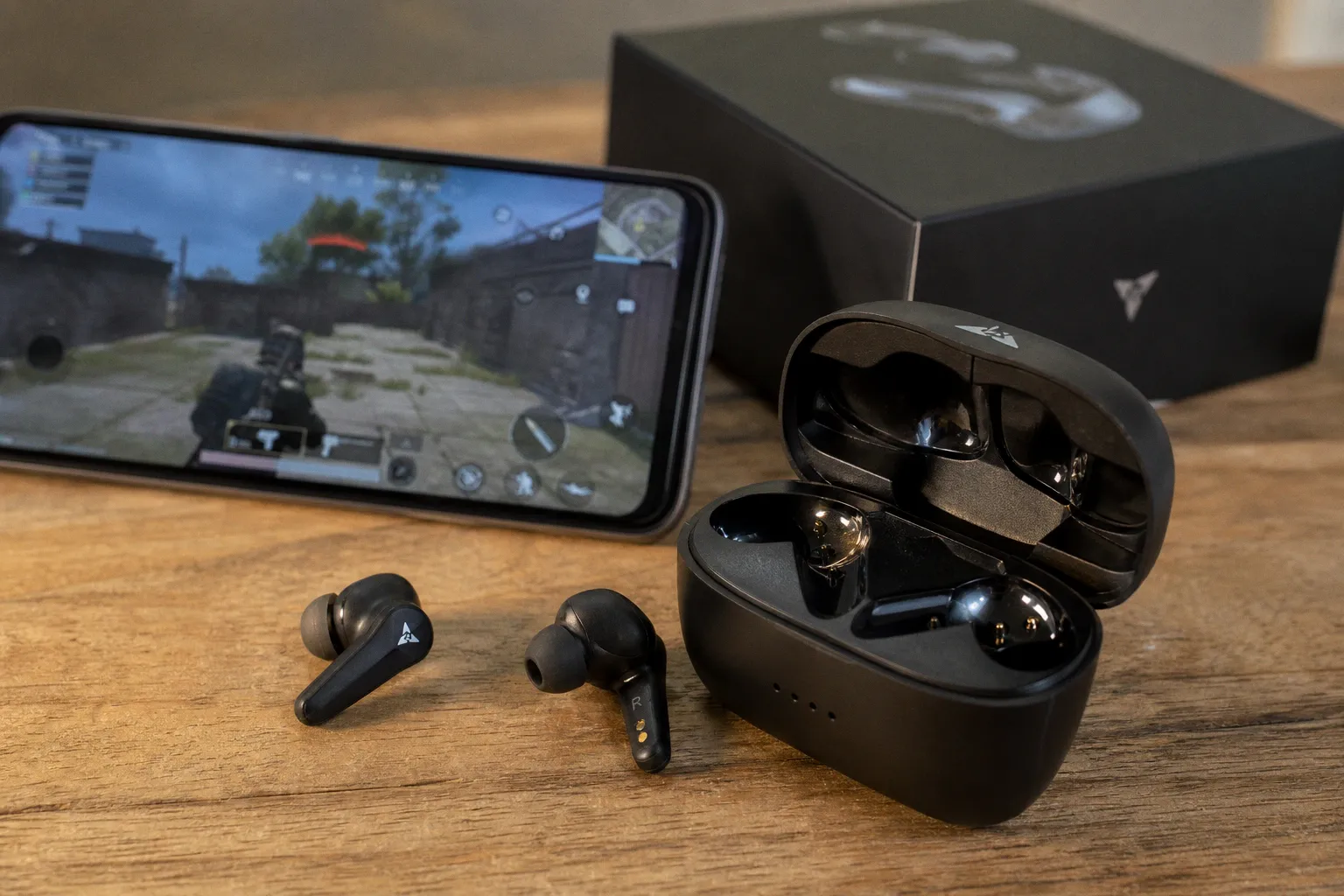
That is the real problem with gaming earbuds under 3000 INR. Most product pages sell RGB cases, “beast mode” labels, and oversized bass claims. None of that wins a 1v2 in Pochinki or keeps a COD Mobile ranked match clean. The useful checks are narrower: latency, drivers, Bluetooth version, battery, and durability. Five specs. Measurable enough. Easy to fake in advertising. Worth reading carefully.
1. Latency: 60ms Is the Line, Not the Slogan
Latency is the first filter. If the earbuds cannot keep audio delay under control, the rest of the spec sheet becomes decoration.
For competitive mobile gaming, the target is simple: look for a dedicated gaming mode rated at 60ms or lower. Anything above 100ms is usually noticeable. Not always in music. Not always in casual YouTube playback. In-game, it shows up fast.
In BGMI, the problem is directional timing. A footstep from a staircase, a reload behind cover, a vehicle closing from the left — these cues are useful because they are early. Delayed audio turns early information into late confirmation. That is a bad trade.
Free Fire exposes the same issue differently. Fights are shorter. Movement is sharper. Audio lag makes close-range shotgun and SMG exchanges feel detached from the screen.
COD Mobile is less forgiving in another way. The game already runs fast on decent hardware. If the phone is pushing 90Hz or 120Hz while the earbuds are lagging, the player gets clean visuals with lazy sound. That mismatch is easy to notice.
If the gaming mode is above 100ms, it is not a competitive feature. It is a sticker on the box.
There is one catch: manufacturer latency claims are not lab truth. A brand may print 40ms or 50ms, but real-world latency varies by phone chipset, codec support, game engine, wireless congestion, and firmware behavior. Budget earbuds rarely give enough technical disclosure to verify the chain.
So the practical check is harsher:
- If there is no dedicated gaming mode, skip for competitive play.
- If the claimed latency is not stated in milliseconds, treat it as non-competitive.
- If the claim is above 60ms, expect visible delay in fast games.
- If reviews mention audio desync, mode instability, or random reconnection, do not excuse it because the driver size is large.
Low latency does not mean zero latency. Wireless earbuds cannot match a wired 3.5mm headset for raw delay. That is physics and signal processing, not opinion. But under 3000 INR, the job is not perfection. The job is keeping the delay low enough that the player does not have to manually compensate.
2. Drivers: 10mm to 13mm Is Normal, Tuning Still Matters
The budget gaming earbud market likes large numbers. Driver size is one of its favorite tools. A 13mm dynamic driver sounds more serious than a 10mm one. Sometimes it helps. Often it just makes the bass louder.
In this price band, 10mm to 13mm dynamic drivers are the standard range. That is enough physical size for the low-end pressure gamers expect from grenades, vehicles, and gunfire. It can also support clear enough mid-bass to make footsteps readable.
But driver size is not the whole story. Tuning decides whether that bass helps or harms.
Too much bass masks footstep detail. The explosion sounds thick. The lobby music sounds heavy. The product page looks good. Then a crouch-walking enemy becomes harder to place because the lower frequencies smear over the mids.
Too little bass has its own issue. Gunfire loses weight. Vehicle distance becomes less obvious. Directional cues can feel thin, especially in noisy rooms or at low volume.
A sensible gaming tuning under 3000 INR should do three things:
1. Keep footsteps forward enough to locate movement.
Footstep cues sit in a region that can be buried by bloated bass. If every impact sounds like a mini-subwoofer test, the tuning is wrong for esports.
2. Avoid sharp treble fatigue.
Some budget earbuds lift treble to create fake “detail.” It works for five minutes. It becomes irritating during a three-hour scrim block.
3. Maintain separation during chaos.
The real test is not one clean gunshot in training ground. It is multiple sound layers: squad comms, nearby firing, vehicle audio, zone effects, and footsteps. Cheap tuning collapses there.
This is where product categories blur. Lifestyle earbuds are often tuned for vocals, calls, reels, and daily listening. Gaming earbuds need stricter timing and cue clarity. For broader non-gaming buying context around personal tech and self-care routines, a resource like Empress World sits in a different lane; for mobile esports hardware, the priority remains measurable in-match response.
Do not overpay for driver size alone. A 13mm driver with muddy tuning is less useful than a 10mm driver with cleaner separation. Under 3000 INR, assume compromise. The better question is where the compromise sits.
3. Bluetooth 5.3: Stability Is a Performance Spec
Bluetooth version does not get the same attention as latency mode. It should.
For current budget gaming earbuds, Bluetooth 5.3 is the standard to look for. It generally brings better power efficiency and more stable connection behavior than older Bluetooth 5.0 or 5.1 implementations. That matters in Indian mobile gaming because matches are not always played in clean RF conditions.
A crowded PG room. A college canteen. A LAN warm-up area. A local tournament desk with multiple phones, routers, controllers, smartwatches, and TWS cases in the same space. Wireless stability gets tested there.
Connection instability shows up in small, match-losing ways:
- One earbud drops for half a second during a fight.
- Gaming mode turns off after reconnecting.
- Audio shifts from stereo to a flatter profile during calls or comms.
- The left-right sync drifts slightly.
- The earbuds reconnect slowly after being placed back in the case.
The spec sheet will not always admit this. But Bluetooth 5.3 at least gives the product a better baseline. It is not a guarantee of good firmware. It is a minimum checkpoint.
Here is the practical comparison:
| Parameter | Acceptable Under 3000 INR | Weak Buy Signal |
|---|---|---|
| Bluetooth version | 5.3 | 5.0 or unclear listing |
| Gaming mode | Listed with ms figure | Vague “low latency” wording |
| Latency target | 60ms or lower | Above 100ms or not disclosed |
| Connection behavior | Fast pairing, stable stereo | Dropouts, delayed reconnects |
| Use case fit | BGMI, Free Fire, COD Mobile sessions | Casual music-first positioning |
Codec support also matters, but budget listings often hide or oversimplify it. Many phones and earbuds fall back to common Bluetooth audio paths anyway. That is why real gaming mode behavior matters more than codec branding at this price.
One more point: do not confuse Bluetooth version with latency by itself. Bluetooth 5.3 does not automatically mean 40ms gaming audio. It improves the platform. The earbuds still need firmware tuned for low-latency operation.
4. Battery Life: Total Hours Are Less Useful Than Session Hours
Battery claims are another messy area. A case may advertise 40 hours, 50 hours, sometimes more. That number includes repeated recharges from the case. It does not tell you whether the earbuds survive a long ranked grind on one charge.
For budget TWS gaming earbuds, the baseline should be:
- 30+ hours total battery life with the case.
- At least 5 to 6 hours of continuous playback from the earbuds.
- Fast top-up support if available, though not at the cost of basic endurance.
- Clear disclosure of battery life with gaming mode, if the brand provides it.
Gaming mode can drain faster than standard mode. Higher polling behavior, lower latency processing, and aggressive connection management can reduce runtime. Many brands print the bigger music playback number and stay quiet about gaming endurance.
That silence is not accidental.
For mobile esports use, continuous battery life is the better metric. A player may run classic matches, TDM warm-ups, scrims, Discord calls, and post-match review without wanting to dock the earbuds every two hours. The case battery helps between sessions. It does not help mid-fight.
Case battery is convenient. Earbud battery is performance. Do not mix the two.
Also watch the charging case itself. Under 3000 INR, case hinges and charging pins can be weak points. If the earbuds fail to seat properly, the advertised battery life becomes irrelevant. One bud charges. The other sits at 12%. The next match starts with mono audio. This is not rare enough to ignore.
A reasonable battery reading should separate the numbers:
| Battery Metric | What It Means | Gaming Relevance |
|---|---|---|
| Earbuds per charge | Runtime before docking | High |
| Total with case | Full cycle capacity | Medium |
| Gaming mode runtime | Runtime with low latency active | High |
| Fast charge | Emergency top-up | Useful, not primary |
| Standby drain | Battery loss when unused | Low to medium |
If the listing only screams total battery hours and hides single-charge runtime, read that as a warning. Not a deal-breaker every time. A warning.
5. Microphone and ENC: Good Enough Is Not Guaranteed
The microphone is where budget gaming earbuds become unpredictable.
Many earbuds under 3000 INR claim ENC — Environmental Noise Cancellation — for calls. This is not the same as ANC. Active Noise Cancellation is for reducing noise heard by the listener. ENC is usually microphone-side processing designed to reduce background sound during calls.
Do not assume all budget gaming earbuds have ANC. Many do not. Many should not spend their budget trying.
For mobile gaming, microphone quality matters because squad communication is time-sensitive. A late callout is bad. A muffled callout is also bad. “One guy roof” and “one guy room” are not the same instruction.
The issue is that ENC performance varies wildly between brands and models in this price bracket. Without testing a specific unit, it cannot be generalized. Some earbuds suppress fan noise but distort speech. Some keep the voice natural but let traffic through. Some sound fine indoors and collapse outdoors.
A usable mic for gaming should handle:
- Ceiling fan noise without pumping the voice volume.
- Light traffic or room chatter without clipping speech.
- Fast callouts without cutting the first syllable.
- Long sessions without heat or fit movement changing mic pickup.
- Game audio plus voice chat without forcing teammates to ask for repeats.
Stem design can help, because the microphone sits closer to the mouth. But stem length alone is not proof. DSP tuning matters. Mic placement matters. Wind handling matters.
If a product page says “quad mic ENC,” treat it as a starting point, not evidence. Four weak mics with rough processing still sound weak. Two decent mics with cleaner processing may perform better.
This is one of the few specs where user video reviews can be useful. Not because every reviewer is precise. Because a raw mic sample reveals more than a badge.
6. IP Rating and Build: IPX4 Is the Floor
Gaming earbuds are small, cheap, and handled badly. They get tossed into bags, used during sweaty sessions, placed on dusty tables, and worn outdoors between matches. Build quality is not cosmetic. It decides whether the earbuds remain consistent after two months.
The durability baseline is IPX4 or higher. IPX4 means resistance to splashing water. For gaming earbuds, that mostly translates to sweat and light exposure protection. It does not mean waterproof. It does not mean shower-safe. It does not mean monsoon-proof.
But below IPX4, the risk rises. Sweat can affect charging contacts. Moisture can interfere with mesh filters. Long sessions can expose weak sealing and adhesive choices.
Fit is part of durability too. Loose earbuds force volume increases and ruin directional consistency. A poor seal reduces bass and makes footsteps harder to read. Then the player blames the driver when the real issue is the ear tip fit.
Under 3000 INR, check the physical package with the same suspicion used for latency claims:
1. Ear tips: At least multiple sizes. A single poor fit ruins audio positioning.
2. Case hinge: No excessive wobble if reviews mention it repeatedly.
3. Charging pins: Buds should seat cleanly and charge reliably.
4. Touch controls: Accidental taps are a problem during grip adjustment.
5. IP rating: IPX4 minimum for sweat resistance.
Touch controls deserve special attention. Mobile gamers adjust grip constantly. If the earbuds register accidental touches while the player shifts position, gaming mode may toggle, music may pause, or voice assistant may trigger. Physical buttons are rare in TWS now, but touch sensitivity tuning matters.
RGB lighting, transparent lids, and aggressive case shapes do not improve frame pacing, ping, or sound timing. They may look aligned with gaming branding. That is the end of their contribution.
How the Five Checks Work Together
No single spec carries the whole product. A cheap earbud can have low latency and poor battery. Another can have stable Bluetooth and muddy drivers. A third can sound decent but fail at microphone clarity.
The best under-3000 INR choice is usually the one with the fewest match-impacting flaws. Not the loudest claim.
Use this priority order if the earbuds are mainly for BGMI, Free Fire, or COD Mobile:
| Priority | Spec | Minimum Target | Why It Matters |
|---|---|---|---|
| 1 | Latency | Gaming mode at 60ms or lower | Keeps cues aligned with action |
| 2 | Stability | Bluetooth 5.3 | Reduces dropouts and pairing issues |
| 3 | Battery | 5–6 hours per charge, 30+ total | Survives long sessions |
| 4 | Drivers | 10mm–13mm dynamic | Enough range for effects and cues |
| 5 | Protection | IPX4 or higher | Handles sweat and daily use |
| 6 | Microphone | Tested clarity preferred | Needed for squad comms |
The microphone sits sixth only because it is hard to verify from the spec sheet. In actual squad play, it can matter as much as drivers. But buying decisions need measurable anchors, and mic claims in this segment are too inconsistent to rank cleanly without samples.
There is also the phone side. A high-refresh gaming phone with a stable chipset can expose poor earbuds more clearly. If the display is responsive and touch latency is low, audio lag becomes more obvious. Players using iQOO, ROG Phone, OnePlus, Realme GT, or other performance-focused devices should be stricter, not more forgiving. Better phone performance does not fix slow earbuds. It highlights them.
The Common Traps Under 3000 INR
The budget segment is full of traps because the price is low enough to encourage impulse buying. That is exactly where bad specs hide.
The first trap is “gaming” branding without latency disclosure. If the product does not state a millisecond figure, it may still be usable for casual gaming. It should not be treated as competitive audio gear.
The second trap is oversized bass. Loud low-end feels impressive in a 20-second demo. It can reduce positional clarity in real matches.
The third trap is total battery exaggeration. A big case number looks strong. The earbuds themselves may still die too quickly.
The fourth trap is confusing ENC with ANC. ENC may help teammates hear the player. ANC reduces external sound for the listener. Different systems. Different purpose.
The fifth trap is ignoring fit. Even a technically decent earbud performs badly with a poor seal. Audio positioning depends on consistent left-right balance and stable insertion depth. That is basic acoustics.
Buy or Skip Verdict
Buy gaming earbuds under 3000 INR only if they clear the core technical floor: gaming mode at 60ms or lower, Bluetooth 5.3, 5–6 hours of earbud runtime, 30+ hours total battery, 10mm–13mm drivers, and IPX4 protection. Those numbers are not luxury specs. They are the baseline for budget mobile esports use in 2024 hardware terms.
Skip models that lean on lighting, aggressive names, or vague “ultra-low latency” claims without a millisecond figure. Skip anything above 100ms if competitive play is the goal. Skip earbuds that hide single-charge battery life. Be cautious with microphone promises unless there are real samples.
Price-to-performance is strict here. Under 3000 INR, good earbuds do not need to be dramatic. They need to be consistent. Low delay. Stable connection. Usable battery. Clear enough cues. No nonsense. That is the buy signal.