Where is the GodLike Esports bootcamp located?
The GodLike Esports bootcamp is not tucked somewhere in “Mumbai” in the loose, thumbnail-friendly way people often say it online. Its official address is Ghanshyam Villa, Plot no.
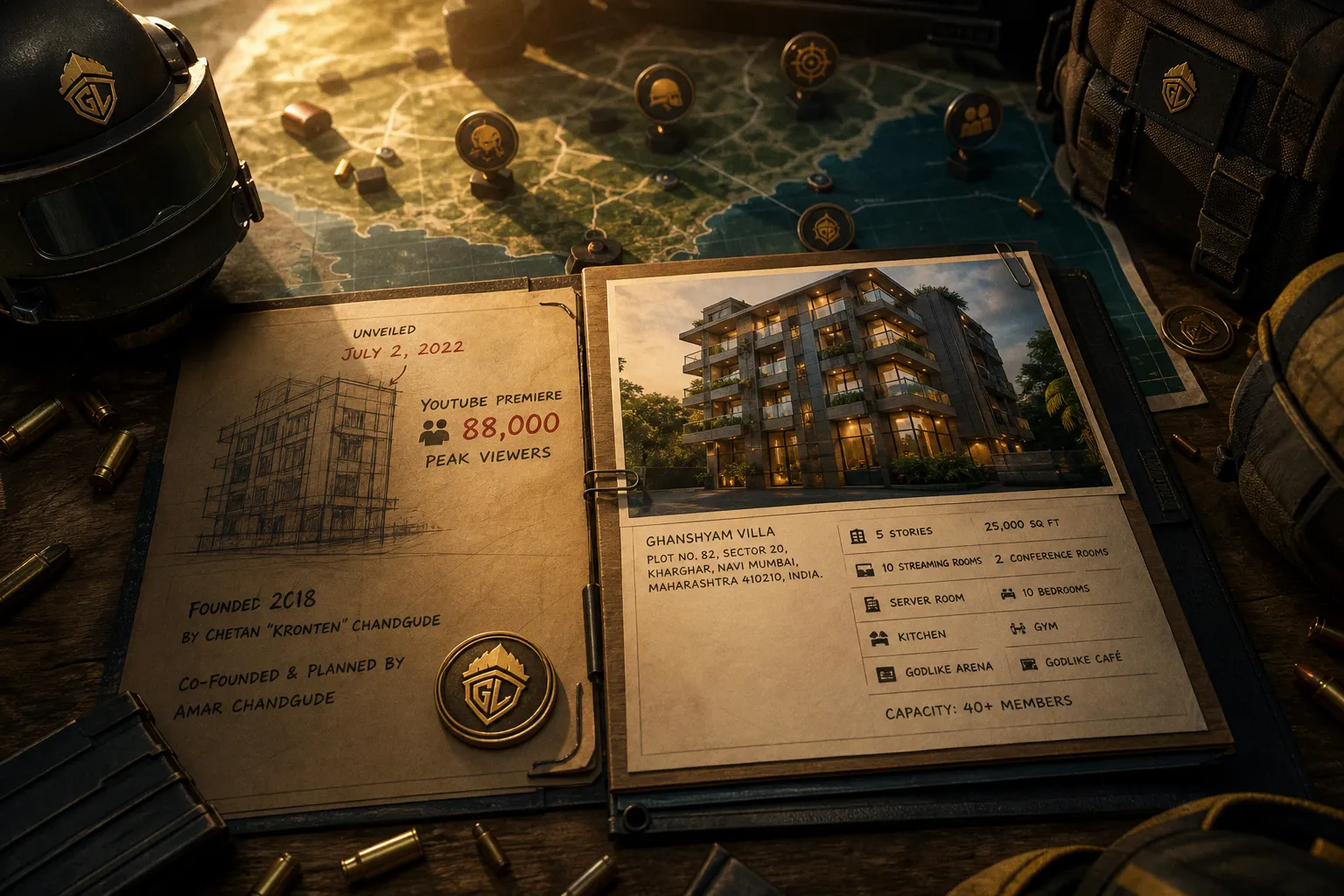
And “bootcamp” almost feels too small a word here. The GodLike Esports bootcamp is a five-story, 25,000-square-foot gaming house designed to hold more than 40 people across players, creators, and management. It is residence, training block, content factory, team headquarters, and emotional pressure chamber all at once — the kind of place where a roster’s day does not end when scrims end, because the building itself keeps humming.
The GodLike bootcamp location: Kharghar, Navi Mumbai, not central Mumbai
Let’s pin it down first, because this is the question that brings most people here.
The GodLike gaming house address is:
Ghanshyam Villa, Plot no. 82, Sector 20, Kharghar, Navi Mumbai, Maharashtra 410210, India.
That matters for more than map accuracy. Kharghar is not central Mumbai. It is part of Navi Mumbai, a planned satellite city with broader roads, more residential pockets, and the kind of larger standalone properties that are simply harder to imagine in the cramped, vertical squeeze of old Mumbai.
For an esports organisation, that difference is practical. A proper bootcamp needs space that can absorb noise, long hours, equipment movement, creator traffic, staff logistics, and the strange sleep rhythm of professional gaming. It needs rooms that can stay lit at 2 a.m. without turning the whole house into a battlefield. It needs zones: for playing, for streaming, for meetings, for recovering, for eating, for being briefly human away from the game.
GodLike’s Kharghar address gives the organisation that canvas. A 25,000-square-foot, five-floor mansion is not just a flex for a tour video; it is a way of declaring that Indian mobile esports has grown out of the one-room grind setup.
The address is Kharghar, but the point is larger: GodLike built a house around the life of an esports athlete, not just around the matchday camera.
When the facility was unveiled publicly on July 2, 2022, the reveal itself carried the scale of the moment. The YouTube premiere peaked at 88,000 concurrent viewers — a number that says as much about GodLike’s fan base as it does about the curiosity around Indian esports infrastructure. People were not only watching a building. They were watching a symbol of arrival.
Inside the GodLike Esports bootcamp: what the five floors actually hold
The confirmed layout tells you why fans keep searching for “inside GodLike bootcamp” years after the reveal. This is not a casual gaming flat dressed up with RGB lights. The facility includes ten streaming rooms, two conference rooms, a server room, ten bedrooms, a kitchen, a gym, the GodLike Arena, and a GodLike Café.
Each of those rooms serves a different version of the same mission: keep talent close, supported, visible, and competition-ready.
| Facility area | What it supports | Why it matters in a pro esports house |
|---|---|---|
| Ten streaming rooms | Individual creator and player broadcasts | Lets players and creators produce content without fighting for space or silence |
| GodLike Arena | Team activity, fan-facing content, internal events | Gives the organisation a central stage instead of relying only on external venues |
| Two conference rooms | Reviews, planning, sponsor calls, roster discussions | Keeps the business and competitive sides from bleeding chaotically into practice areas |
| Server room | Technical backbone and equipment control | A serious setup needs stable infrastructure, not improvised cabling under desks |
| Ten bedrooms | Residential living for players and members | Reduces commute fatigue and keeps rosters together during demanding schedules |
| Kitchen and café | Daily meals, informal decompression | Team culture often forms between sessions, not during them |
| Gym | Physical conditioning and stress release | The body carries pressure even when the game is played on a screen |
The most revealing detail, to me, is not one room. It is the separation of rooms. A weaker facility forces every need into the same space: practice becomes content, content becomes noise, noise becomes stress, and stress becomes someone’s underperformance. A stronger facility gives pressure somewhere to go.
That is what a mature bootcamp tries to do. It does not magically make a player calm in a final circle or perfect in a clutch round. But it can remove some of the needless friction around him: the unstable internet, the lack of privacy, the awkward recording setup, the no-place-to-reset problem that wears people down slowly.
GodLike’s mansion is built around the understanding that modern esports talent is not one thing. A player may be scrimming in the afternoon, streaming in the evening, filming branded content the next day, sitting through VOD review after dinner, and living in the same ecosystem throughout. That is a heavy rhythm. The building has to carry some of that weight.
A 25,000-square-foot facility for 40+ people: why the scale matters
The headline number is 25,000 square feet. Big, yes. But in esports, raw square footage only becomes meaningful when it changes how people work.
GodLike’s bootcamp was designed to house over 40 team members, including athletes from rosters such as BGMI, CODM, and Free Fire, along with content creators and management. That mix is important. It means the house is not built only for a five-man active lineup with a coach hovering behind them. It is built for an organisation whose public identity lives across competitive results, creator reach, fan engagement, and the daily theatre of Indian gaming culture.
A 40-plus-person house creates its own weather. There is always someone awake. Someone has just won a scrim. Someone has had a poor block and is pretending it did not cut deep. Someone is recording. Someone is editing. Someone from management is trying to make the next shoot and the next tournament calendar fit into the same impossible week.
In that kind of environment, the design has to protect both intensity and recovery. The best players I have watched up close are not machines; they are young people trained to look composed while being measured every day by teammates, fans, coaches, and strangers with slow-motion opinions. They need discipline, yes. But they also need a structure that does not turn every corridor into another scoreboard.
The GodLike bootcamp attempts to answer that with dedicated training and creator spaces rather than one shared chaos zone. Ten streaming rooms alone tell you the organisation understands the content economy around esports. A pro player today is rarely allowed to be only a pro player, especially in India’s mobile gaming ecosystem. Visibility feeds fandom. Fandom feeds commercial value. Commercial value helps fund rosters, salaries, bootcamps, travel, and the long grind between trophies.
That cycle is not always gentle on players. But pretending it does not exist would be dishonest. GodLike’s facility is one of the clearest physical expressions of that new contract: compete hard, create constantly, live under the brand’s roof, and try not to lose yourself in the process.
The GodLike Esports bootcamp price question: what is known and what is not
Search interest around “GodLike esports bootcamp price” is understandable. A five-story mansion in Kharghar, spread across 25,000 square feet, naturally invites speculation. Fans want the number. Rivals want the comparison. Creators want the shock value.
But the exact monthly rent, purchase cost, or verified property valuation of Ghanshyam Villa has not been officially established through reliable public documentation. Some numbers circulate in vlogs and fan discussions, but unless they are backed by official real estate records or a direct organisational disclosure, they should stay in the category they belong to: unverified.
What can be said with confidence is narrower, but stronger:
1. The facility is large by Indian esports standards. At 25,000 square feet and five floors, it sits among the most ambitious gaming houses built in the country.
2. It was not designed as a temporary scrim flat. The presence of streaming rooms, conference rooms, a server room, gym, café, arena, and residential bedrooms points to long-term organisational use.
3. Its operational cost is likely significant, even without naming a figure. Housing 40-plus members, maintaining equipment-heavy rooms, running creator spaces, and supporting daily food, staff, utilities, and technical infrastructure is not a lightweight expense.
4. The symbolic cost is also part of the story. Once an organisation builds at this scale, the house itself becomes a promise to fans, sponsors, and players — and promises create pressure.
This is where I am careful with the romance of big esports houses. They look glamorous from the outside, and GodLike’s reveal was meant to look glamorous. But every permanent facility also raises the bar for what people expect from the teams inside it. If you train in a landmark bootcamp, the audience does not easily accept “we are still building” as an answer.
A giant bootcamp does not win the match for you. It only removes excuses loudly enough that the real work has nowhere to hide.
That is not a criticism of GodLike. It is the nature of infrastructure. Better rooms, better equipment, better schedules — they sharpen the edge. They also make every loss feel more public.
Kronten, Amar Chandgude, and the vision behind the build
GodLike Esports was founded in 2018 by Chetan “Kronten” Chandgude, a name that carries unusual weight in Indian mobile gaming because he belongs to that bridge generation: creator, organiser, public face, and builder. The bootcamp project was co-founded and planned by Amar Chandgude, and that detail matters because a facility like this is not born from one dramatic idea. It takes planning, money, stubborn logistics, and a belief that esports in India deserves physical permanence.
For years, Indian esports had to make do with temporary arrangements: rented flats, mixed-use houses, gaming cafés after hours, improvised streaming corners, and players living between home expectations and competitive ambition. That era produced great talent, but it also produced burnout, inconsistency, and a constant feeling that the scene was asking athletes to be professional without always giving them professional conditions.
The GodLike bootcamp was a statement against that half-built reality. Not the only one in India, not the final answer, but a loud and visible one.
In a country where mobile gaming fandom can be enormous and brutally immediate, the move also tied GodLike’s identity to a physical home. Fans could point to a place. Players could arrive at a building that said, before anyone spoke, that this was serious. Sponsors could see rooms, not just metrics. Management could centralise operations. Content creators could shoot, stream, and collaborate without building a new setup each morning from a tangle of wires and borrowed corners.
The July 2022 unveiling landed because it gave shape to something fans already felt: GodLike was not trying to behave like a small team anymore. It was building like an institution.
Why Kharghar works for a gaming house of this size
Kharghar gives the bootcamp a different rhythm than a central-city base would. For a five-floor mansion housing dozens of people, the location is not incidental. Navi Mumbai’s residential pockets allow for larger properties, more controlled movement, and a degree of separation from the crush of Mumbai’s densest commercial zones.
That separation can be healthy for esports athletes, though it comes with its own trade-offs. A quieter, more spacious location supports focus. It also means the bootcamp becomes a self-contained world, and self-contained worlds need careful management. If the culture inside is good, the house can become a stabilising force. If the culture turns tense, there are fewer natural exits.
A strong bootcamp therefore is not just a real estate decision. It is a human systems decision.
For players across BGMI, CODM, Free Fire, and other mobile titles, the day-to-day realities are repetitive and demanding. Training blocks, device checks, meta shifts, role clarity, review sessions, creator obligations, tournament calls — none of it looks as cinematic as a final killfeed, but this is where careers are either steadied or slowly chipped away.
The GodLike facility’s mix of bedrooms, streaming zones, conference rooms, and physical fitness space suggests an understanding that performance is not created only at the gaming desk. It is created in how quickly a player can sleep after a bad day, how honestly a team can review mistakes without turning them into personal wounds, how reliably the internet holds, how much silence exists after a loud stream, and whether the organisation gives people enough structure to withstand the public heat around them.
What the GodLike bootcamp tells us about Indian esports now
The GodLike Esports bootcamp is easy to describe in numbers: 25,000 square feet, five floors, ten streaming rooms, ten bedrooms, two conference rooms, a server room, a gym, an arena, a café, 40-plus members, unveiled on July 2, 2022, with 88,000 peak concurrent viewers watching the reveal.
But numbers are only the frame. The deeper story is that Indian mobile esports has reached a point where top organisations are no longer building only rosters. They are building habitats.
That changes the conversation around players. A young athlete entering a place like this is not just joining a team; he is entering an ecosystem with cameras, expectations, teammates, coaches, creators, management, fans, and the invisible weight of the GodLike name. That can be inspiring. It can also be heavy. Sometimes both before lunch.
For fans, the bootcamp offers a clearer way to understand what professionalism looks like beyond match results. It is not just a jersey, a logo, or a viral montage. It is the less glamorous infrastructure that lets talent repeat good habits until they harden into performance: rooms that are ready, schedules that hold, reviews that happen, meals that appear, equipment that works, and people who know what their role is when pressure starts pressing its thumb into the day.
So, where is the GodLike Esports bootcamp located? In Kharghar, Navi Mumbai — officially at Ghanshyam Villa, Plot no. 82, Sector 20, Maharashtra 410210.
But if you are asking what it represents, the answer is wider. It represents the moment Indian esports stopped treating elite gaming houses as borrowed luxury and started treating them as part of the competitive machine. The building does not make GodLike untouchable. No building can. But it gives its players, creators, and staff a serious stage on which to carry the burden of being watched — and, on the best days, to turn that burden into something bright enough for the whole scene to feel.